Product Description
Industrial CZPT Alloy Steel Link Chain 7mm
1,Our load chain pasted 11 times test before the shipment in order to keep stable quality.If you required the detail , please contact me and ask it .
2, Our broken test is higher than G100 chain standard requirement at lest .We have TUV test report No.15061451 002 .
3, Our own special models (see the below pictures) keep the Nice Shape , No Twist, 2 times calibrations keep Exact Size .It can be used for sling , but also for electric hoist .
4,Intermediate frequency heat treatment process keep to meet G100 chain strength requirement, elongation and suitable hardness (38HRC to 42HRC).We also can meet special hardness for hoist factories` requirement .We test the hardness more carefully (see below pictures).
5,Supply technology support .Design the chain according to clients` requirement
6, Supply Polished, Oxidated black,electric Galvanization,painted cover , Plastic power cover,Dacromet.Our painted cover is done in warm room which with high color fastness.It is difficult to remove by knife in Europe client`s lab.
G100 Chain Information:
Material:Alloy steel
Safety rate:Min.Safety factor is 4 SWL.
Applications:Lifting chain, lifting beam, chain hoist, lever hoist,electric hoist,lashing ,chain sling ,tie down and so on.
G80 LIFTING CHAIN | |||||||||||||
| ITEM NO. | SIZE DXP(MM) | WIDTH(MM) | APPROX WEIGHT(KG/M) | WORKING LOAD LIMIT(T) | TEST LOAD(T) | BREAKING LOAD MIN.(KN) | |||||||
| INSIDE MIN. | OUTSIDE MAX. | ||||||||||||
| GL571-01 | 6×18 | 7.5 | 21 | 0.79 | 1.1 | 27 | 45.2 | ||||||
| GL571-02 | 7×21 | 9 | 24.5 | 1.07 | 1.5 | 37 | 61.6 | ||||||
| GL571-03 | 8×24 | 10 | 28 | 1.38 | 2 | 48 | 80.4 | ||||||
| GL571-04 | 10×30 | 12.5 | 35 | 2.2 | 3.2 | 76 | 125 | ||||||
| GL571-05 | 13×39 | 16.3 | 46 | 3.8 | 5 | 128 | 214 | ||||||
| GL571-06 | 16×48 | 20 | 56 | 5.63 | 8 | 192 | 320 | ||||||
| GL571-07 | 20×60 | 25 | 70 | 8.6 | 12.5 | 300 | 500 | ||||||
| GL571-08 | 22×66 | 28 | 77 | 10.2 | 15.3 | 366 | 610 | ||||||
| GL571-09 | 26×78 | 35 | 91 | 14.87 | 21.3 | 510 | 850 | ||||||
| GL571-10 | 32×96 | 40 | 106 | 22.29 | 32.2 | 772 | 1286 | ||||||
Payment
| Payment term | L/C | l/c amount above 40.000 usd,we can accept L/C at sight | |
| T/T | EXW | 30% T/T in advance,paid the balance before shipment | |
| FOB | |||
| CIF | 30% T/T in advance,paid the balance against copy of B/L | ||
| cfr(c&f) | |||
| paypal | amount lower than 4000usd | ||
| west | |||
| Delivery time | 15~35days after receiving payment for 1 container |
| We welcome use trade assurance,you`ll enjoy: 100% product quality protection 100% on-time shipment protection 100% payment protection for your covered amount |
| Usage: | Transmission Chain, Drag Chain, Conveyor Chain |
|---|---|
| Material: | 20mn2 |
| Surface Treatment: | Polishing |
| Feature: | Fire Resistant |
| Chain Size: | 1/2"*11/128" |
| Structure: | Top Chain |
| Customization: | Available | Customized Request |
|---|
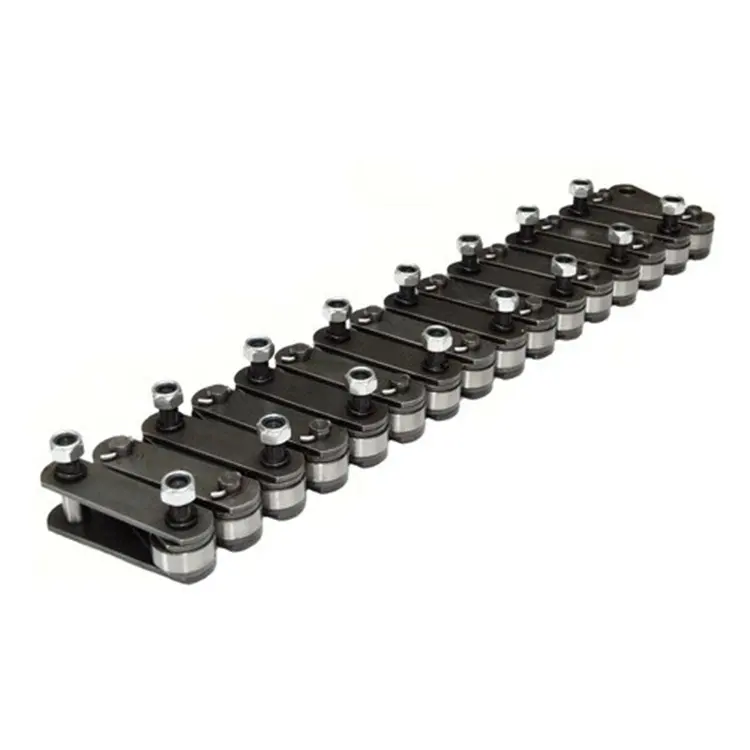
What are the design considerations for a long-span industrial chain conveyor?
Designing a long-span industrial chain conveyor requires careful consideration of several factors to ensure optimal performance and reliability. Here are some key design considerations:
- Chain selection: Choose a chain that is specifically designed for long-span conveyors. Consider factors such as chain strength, wear resistance, and fatigue resistance to handle the load and stress over the extended distance.
- Tensioning system: Implement an effective tensioning system to maintain proper tension in the chain throughout the conveyor’s length. This helps prevent chain slack and ensures smooth operation.
- Support structure: The support structure should be robust and capable of handling the weight of the conveyor and the conveyed materials over the long span. Consider factors such as the material used, structural design, and stability.
- Drive system: The drive system should be appropriately sized and positioned to ensure consistent and efficient power transmission along the entire length of the conveyor. Consider factors such as motor power, gear ratio, and drive unit placement.
- Guiding system: Implement an effective guiding system to keep the chain aligned and prevent deviation or misalignment. This helps ensure smooth and reliable operation, especially over long distances.
- Material handling: Consider the characteristics of the conveyed material, such as size, weight, and flow rate, to determine the appropriate design features such as conveyor width, chain speed, and loading/unloading mechanisms.
- Safety features: Incorporate necessary safety features such as emergency stops, guards, and interlocks to ensure operator safety and prevent accidents.
- Maintenance access: Design the conveyor with easy access points for maintenance and inspection. This allows for routine maintenance tasks, such as chain lubrication and cleaning, to be performed efficiently.
- Environmental conditions: Consider the environmental factors that may impact the conveyor’s performance, such as temperature, humidity, and exposure to contaminants. Choose materials and components that can withstand these conditions.
- Compliance with regulations: Ensure that the design of the long-span industrial chain conveyor complies with relevant safety and industry regulations.
By carefully considering these design considerations, a long-span industrial chain conveyor can be designed to meet the specific requirements of the application, providing reliable and efficient material handling over extended distances.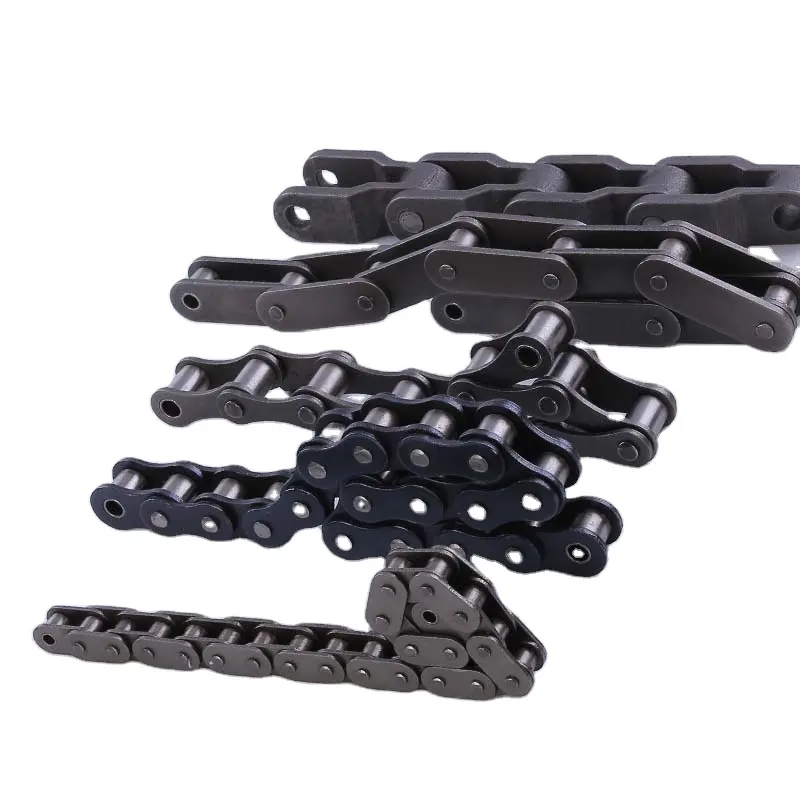
What are the industry standards and regulations for industrial chains?
There are several industry standards and regulations that govern the design, manufacturing, and use of industrial chains. These standards ensure safety, reliability, and performance consistency across different applications. Here are some prominent standards and regulations related to industrial chains:
– ISO 606: This standard specifies the design and dimensions of metric series roller chains used in industrial applications. It provides guidelines for chain pitch, roller diameter, and plate dimensions.
– ANSI/ASME B29.1: This American National Standard covers the design, dimensions, and interchangeability requirements for roller chains, including single, multiple, and double-pitch chains.
– ISO 10823: This standard focuses on the measurement and assessment of chain elongation during operation. It provides guidelines for evaluating the wear and elongation of roller chains.
– OSHA (Occupational Safety and Health Administration): OSHA sets safety standards and regulations to ensure a safe working environment. While it doesn’t specifically address industrial chains, it covers general machine guarding requirements that are applicable to chain-driven machinery.
– Machinery Directive (2006/42/EC): This European directive outlines the essential health and safety requirements for machinery and equipment. It covers aspects such as design, construction, and use of machinery, including industrial chains.
It’s important for manufacturers and users of industrial chains to be aware of these standards and regulations and ensure compliance. Adhering to these standards helps ensure the safety, reliability, and proper functioning of industrial chain systems in various industries.
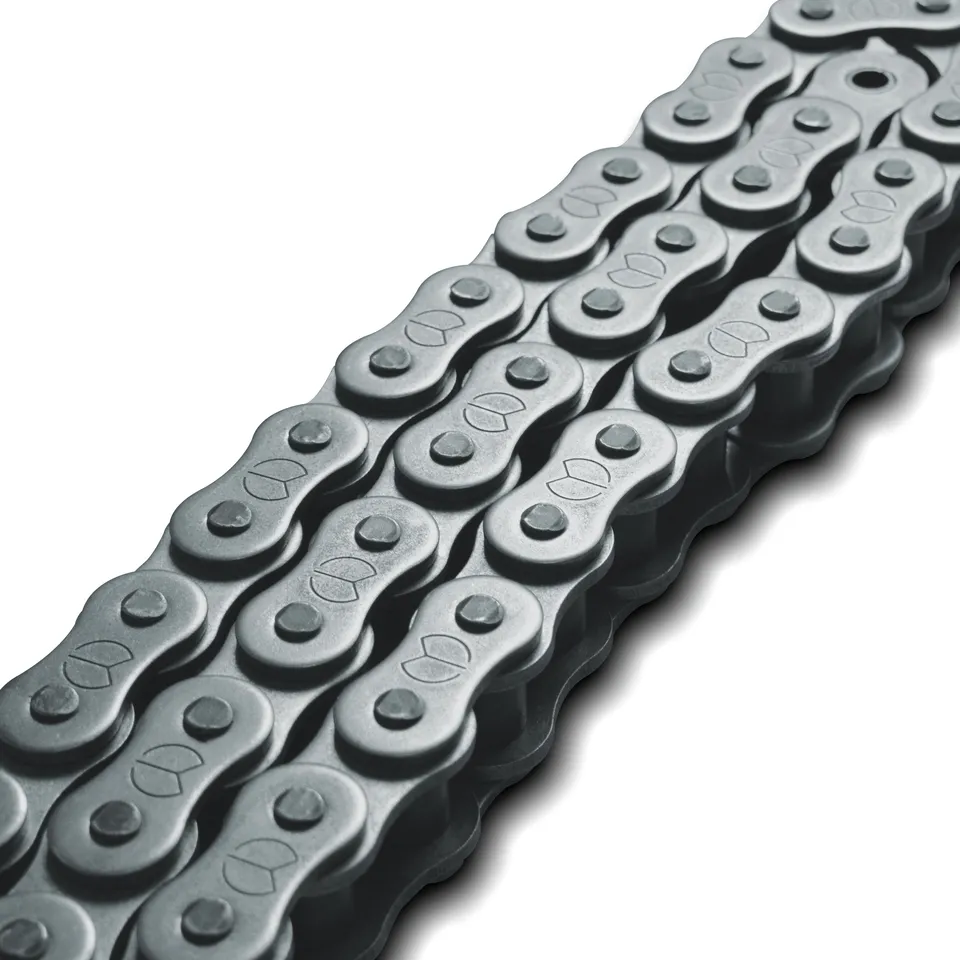
What is an industrial chain and what is its purpose?
An industrial chain, also known as an industrial conveyor chain, is a mechanical device used in various industries for the purpose of conveying or transferring materials or products from one point to another within a production or manufacturing process.
Industrial chains are typically made up of a series of interconnected links, which can be composed of metal, plastic, or other materials depending on the application requirements. These links form a continuous loop that moves materials along the chain’s path.
The primary purpose of an industrial chain is to facilitate the smooth and efficient movement of materials or products within a production system. They are designed to withstand heavy loads, resist wear and corrosion, and operate reliably in demanding industrial environments.
Industrial chains find applications in various industries such as automotive, food and beverage, packaging, mining, agriculture, and many others. They are used in a wide range of processes including assembly lines, material handling systems, conveying systems, and production equipment.
By utilizing an industrial chain, manufacturers can achieve increased productivity, improved workflow, and streamlined operations. The chain’s ability to transport materials or products allows for efficient material flow, reduced manual handling, and enhanced automation.
Overall, the purpose of an industrial chain is to enable the smooth and efficient movement of materials or products, contributing to the overall effectiveness and productivity of industrial processes.


editor by CX 2023-09-05